What Is an Industrial Rugged Tablet?
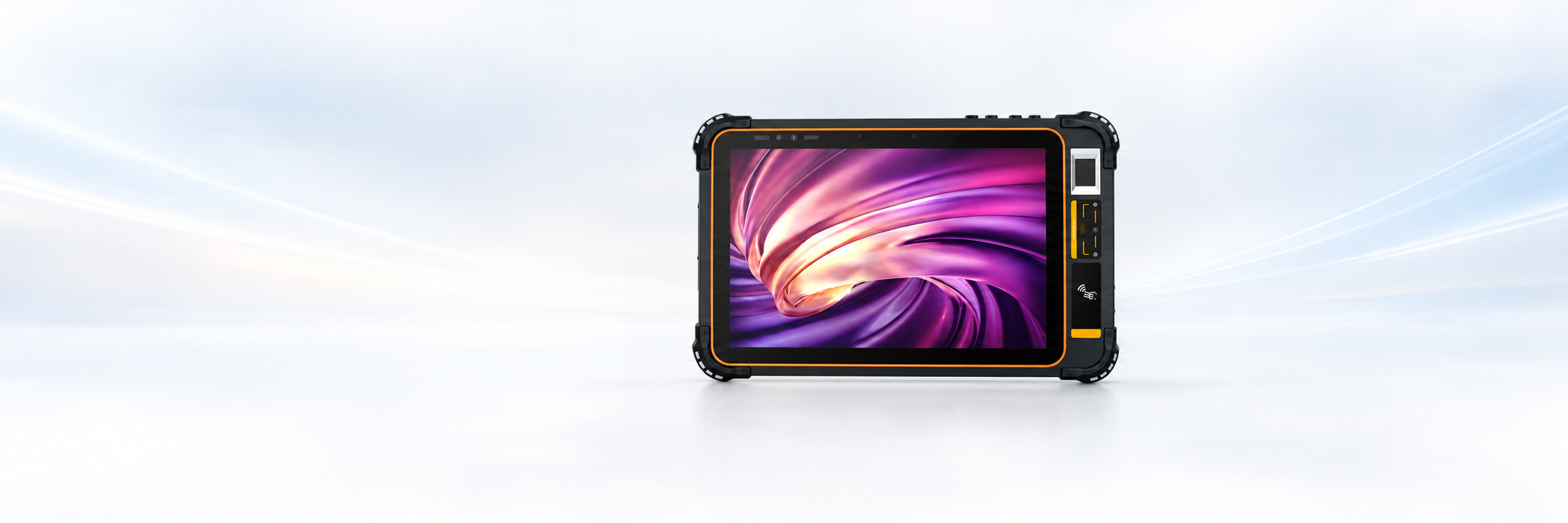
An industrial rugged tablet (also called a rugged tablet PC, three-proof tablet, or IP67 industrial tablet) is a purpose-built computing device engineered to operate reliably in harsh environments where consumer tablets would fail within days or even hours.
Unlike the iPad or Samsung Galaxy Tab designed for climate-controlled offices and living rooms, rugged tablets are deployed in:
- Warehouses with dust, forklift traffic, and temperature fluctuations
- Manufacturing floors with metal shavings, oil mist, and vibration
- Outdoor field service under rain, snow, and direct sunlight
- Cold-chain logistics operating at -20°C or lower
- Construction sites with concrete dust, drops, and impacts
- Healthcare environments requiring frequent disinfection
A properly specified rugged tablet typically delivers a service life of 5–7 years in continuous industrial operation — compared to 6–18 months for a consumer tablet subjected to the same conditions.
The Three "Proofs" of Rugged Tablets
The Chinese term 三防平板 (sān fáng píng bǎn) literally translates to "three-proof tabley," referring to:
| Proof | Protection | Standard |
|---|---|---|
| Dust-proof | Complete ingress protection against particulates | IEC 60529 IP6x |
| Water-proof | Resistance to water jets, splashes, and immersion | IEC 60529 IPx7 |
| Drop-proof | Surviving falls from operational height | MIL-STD-810H Method 516.6 |
Modern rugged tablets often exceed these three basics, adding vibration resistance, temperature extremes, electromagnetic compatibility (EMC), and salt fog corrosion protection for specialized applications.
Rugged Tablet vs Consumer Tablet: 7 Key Differences
When procurement teams evaluate tablets for enterprise deployment, the most common question is: "Can't we just buy consumer tablets with protective cases?"
The short answer is no — and here is the detailed comparison:
1. Sealing & Ingress Protection
| Aspect | Consumer Tablet | Rugged Tablet |
|---|---|---|
| IP Rating | Typically IP52 (drip-resistant) | IP65 (jet-proof) or IP67 (immersion-proof) |
| Dust Protection | Particles enter through ports and seams | Fully sealed against fine dust, metal filings |
| Real-world consequence | Screen glitches, port failure in 3–6 months | Reliable operation for 5+ years |
2. Drop Resistance
Consumer tablets survive approximately 0.5 meters (desk height) onto carpet. Rugged tablets certified to MIL-STD-810H Method 516.6 must survive:
- 1.2–1.5 meters (4–5 feet) drop onto plywood over concrete
- 26-face testing (all corners, edges, and faces)
- Multiple orientations at operating and non-operating temperatures
- Tumble testing (0.5 meter, 100+ rotations)
3. Operating Temperature Range
| Environment | Consumer Tablet | Rugged Tablet |
|---|---|---|
| Standard range | 0°C to 35°C (32°F to 95°F) | -10°C to 60°C (14°F to 140°F) |
| Cold storage | Screen dimming, shutdown below 0°C | Optional -20°C or -30°C variants |
| Hot environments | Thermal throttling above 35°C | Full operation in direct sunlight |
4. Display Readability
| Feature | Consumer Tablet | Rugged Tablet |
|---|---|---|
| Brightness | 300–500 nits | 700–1000+ nits (sunlight-readable) |
| Anti-glare | Glossy, reflective in sunlight | Matte anti-glare with optical bonding |
| Touch technology | Capacitive (finger-only) | + rain mode, glove mode, stylus |
| Durability | Glass breaks on impact | Gorilla Glass or polycarbonate |
5. Battery & Power Management
| Aspect | Consumer Tablet | Rugged Tablet |
|---|---|---|
| Capacity | 6,000–8,000 mAh (non-removable) | 8,000–12,000 mAh (hot-swappable) |
| Replacement | Requires service center | Field-replaceable in <10 seconds |
| Shift coverage | 4–6 hours active use | 8–12+ hours continuous operation |
6. Integrated Industrial Modules
| Module | Consumer Tablet | Rugged Tablet |
|---|---|---|
| Barcode scanner | Camera-based (slow, unreliable) | Dedicated 1D/2D imager (Zebra/Honeywell-class) |
| NFC/RFID reader | Not available | Integrated NFC + optional UHF RFID |
| Fingerprint sensor | Unlocks only | Biometric auth for workforce |
| Serial ports | Not available | RS-232, RS-485 for legacy equipment |
7. Product Lifecycle & Supply Chain
| Factor | Consumer Tablet | Rugged Tablet |
|---|---|---|
| Model availability | 12–18 months before replacement | 5–7 year production lifecycle |
| Spare parts | Discontinued when model ends | 5-year post-EOL guarantee |
| Firmware updates | 2–3 years maximum | Full lifecycle security patches |
Understanding IP Ratings: IP65, IP67, IP68 Explained
The IP (Ingress Protection) code is defined by IEC 60529 and consists of two digits:
First Digit: Solid Object Protection
| Rating | Object Size | Practical Meaning |
|---|---|---|
| 5 | Dust-protected | Limited ingress; not completely sealed |
| 6 | Dust-tight | No dust enters; complete protection |
Second Digit: Liquid Protection
| Rating | Condition | Practical Meaning |
|---|---|---|
| 5 | Water jets | Low-pressure jet from any direction |
| 6 | Powerful jets | High-pressure jet from any direction |
| 7 | Immersion | 1 meter depth, 30 minutes |
| 8 | Deep immersion | Manufacturer-specified depth/time (>1 m) |
| 9K | High-pressure/high-temp | Steam jet cleaning (80°C, 100 bar) |
Which IP Rating Do You Need?
| Application | Recommended IP | Rationale |
|---|---|---|
| Indoor warehouse, light dust | IP65 | Cleaning water jets + airborne dust |
| Outdoor field work, rain | IP67 | Rain, puddles, accidental submersion |
| Maritime, food washdown | IP68/IP69K | Submersion + high-pressure cleaning |
Xinhong Recommendation: For most industrial applications, IP67 provides the best balance of protection level, cost, and design flexibility.
Go deeper: Read our dedicated guide on IP65 vs IP67 vs IP68 protection ratings — it covers exact test conditions, the IK impact code, what IP does not protect against, and how to verify a supplier's claim.
MIL-STD-810H: What Drop Resistance Really Means
MIL-STD-810H is the U.S. Department of Defense test standard for environmental engineering. When a rugged tablet claims "MIL-STD-810H certified," it specifically refers to Method 516.6 (Mechanical Shock).
What the Test Actually Involves
- Drop height: Device dropped from 1.2 meters (4 feet) or 1.5 meters (5 feet)
- Drop surface: Plywood over concrete (not carpet or foam)
- Temperature conditions: Drops at room temp (23°C), low temp (-20°C/-30°C), high temp (+60°C)
- Orientation: All 26 faces/corners/edges tested
- Operational state: Both powered-on and powered-off
- Post-drop verification: Device must power on, display function, touchscreen respond, wireless connect
Why This Matters in Real Operations
| Scenario | Drop Height | Consumer Tablet | Rugged Tablet |
|---|---|---|---|
| Dropped from standing | 1.2–1.4 m | 70% screen crack | Fully functional |
| Fallen from forklift cage | 1.5–2.0 m | Near-certain destruction | Fully functional |
| Dropped in freezing warehouse | 1.2 m @ -20°C | Screen shatters, battery fails | Fully functional |
Key Specifications to Evaluate Before Buying
Core Hardware
| Specification | Entry-Level | Mid-Range | High-Performance |
|---|---|---|---|
| Processor | MediaTek MT6762 | Snapdragon 695 / Intel N100 | Snapdragon 778G+ / Intel i5-i7 |
| RAM | 4 GB | 6–8 GB | 8–16 GB |
| Storage | 64 GB eMMC | 128 GB eMMC | 256 GB SSD / UFS |
| Screen size | 8.0" | 8.0" – 10.1" | 10.1" – 12.0" |
| Brightness | 400 nits | 700 nits | 1000+ nits |
Connectivity
| Feature | Importance | Notes |
|---|---|---|
| Wi-Fi | Critical | Wi-Fi 5 minimum; Wi-Fi 6E preferred for dense deployments |
| Cellular (4G/5G) | Essential for mobile workers | Global band support if operating internationally |
| Bluetooth | Required | BT 5.0+ for scanner, printer, headset |
| GNSS/GPS | Important for field service | Multi-constellation (GPS + GLONASS + BeiDou + Galileo) |
Operating System Selection: Android vs Windows vs Linux
Android (12 / 14) — Best for: Warehousing, Logistics, Retail, Field Service
- MDM ecosystem: Microsoft Intune, SOTI MobiControl, VMware Workspace ONE
- Scanning SDK maturity: Zebra EMDK, Honeywell SDK widely available
- Touch-optimized: Designed for finger/stylus input from day one
- Cost: Lower licensing than Windows
- Battery efficiency: ARM processors deliver longer runtime
Market share: ~65% of rugged tablet deployments globally
Windows (11 IoT / 11 Pro) — Best for: Manufacturing MES, SCADA, Healthcare EMR
- Enterprise app compatibility: Runs existing Win32/.NET applications
- Active Directory integration: Native domain join, Group Policy
- IT familiarity: Existing Windows admin skills transfer directly
Market share: ~30% of rugged tablet deployments
Linux (Ubuntu / Debian / Yocto) — Best for: Embedded Vision, Custom Protocols
- Full customization: Kernel-level modifications possible
- No licensing cost: Free OS, no per-device fees
- Security control: Minimal attack surface, no forced updates
Xinhong Recommendation: For new deployments without legacy Windows dependencies, Android 12/14 offers the best combination of MDM support, scanning performance, battery life, and total cost of ownership.
Go deeper: Not sure yet? Compare the two platforms in depth in our guide to Android vs Windows rugged tablets, including MDM ecosystems, scanning SDK maturity, legacy app strategies and per-unit license cost.
Industrial Modules: Scanner, NFC, RFID, and Biometrics
Barcode Scanning Engine
The barcode scanner is the single most important module for most rugged tablet deployments.
| Scanner Type | Use Case | Readable Codes |
|---|---|---|
| 1D CCD/Linear | Simple retail scanning | Linear barcodes only |
| 2D Imager (Standard) | Warehousing, logistics | 1D + 2D (QR, DataMatrix, PDF417) |
| 2D Imager (Premium) | Healthcare, manufacturing, DPM | Above + screen codes, DPM etched codes |
| Long-range | Warehouse rack scanning (2+ m) | 1D codes at distance |
Key metrics: Decode speed < 0.3 sec | Motion tolerance | Screen decoding | DPM reading capability
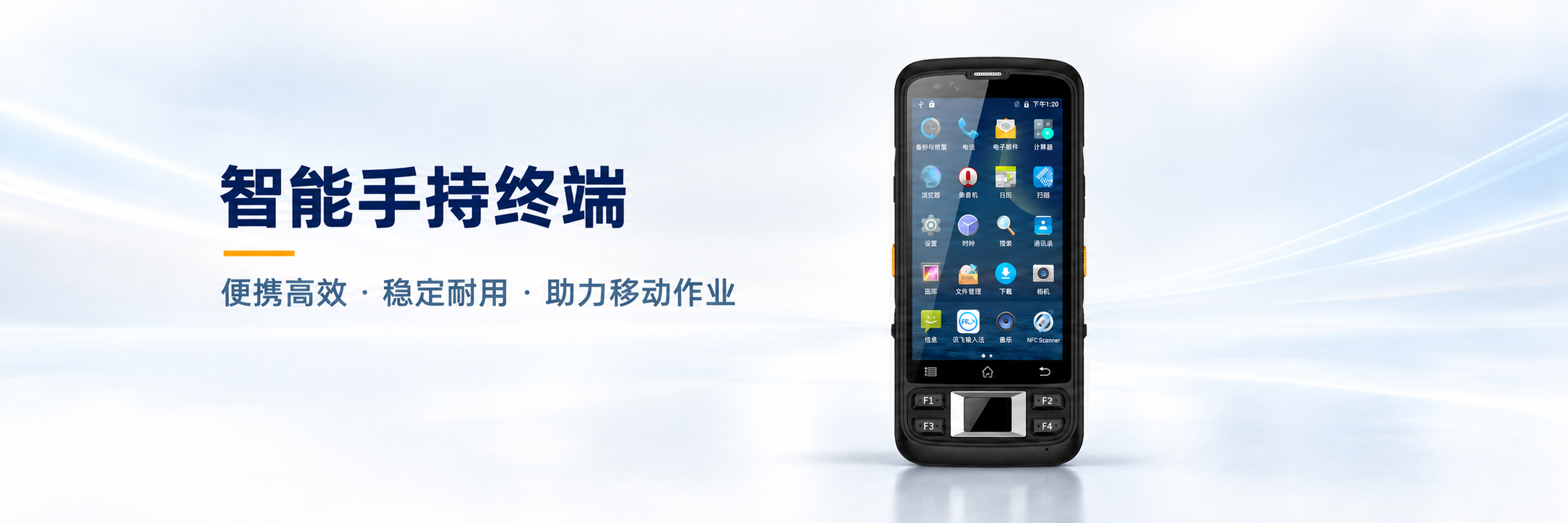
Xinhong offers Zebra SE4710 / SE4750 class and Honeywell N6703 / N3680 class imaging engines across all models.
NFC / RFID
| Technology | Frequency | Range | Use Case |
|---|---|---|---|
| NFC | 13.56 MHz | < 10 cm | Employee badges, smart card auth |
| UHF RFID | 860–960 MHz | 1–8+ meters | Inventory tracking, asset management |
Industry-Specific Recommendations
Warehousing & Distribution Centers
| Requirement | Recommended Spec | Rationale |
|---|---|---|
| Screen size | 10.1" | More area for WMS pick lists |
| Scanner | Premium 2D imager | Damaged codes, screen codes, high-speed |
| Battery | Hot-swappable 8000+ mAh | Continuous shift operation |
| Connectivity | Wi-Fi 6 + BT 5.0 | Dense AP environment |
| OS | Android 12/14 | MDM + scanning SDK maturity |
Manufacturing & Shop Floor
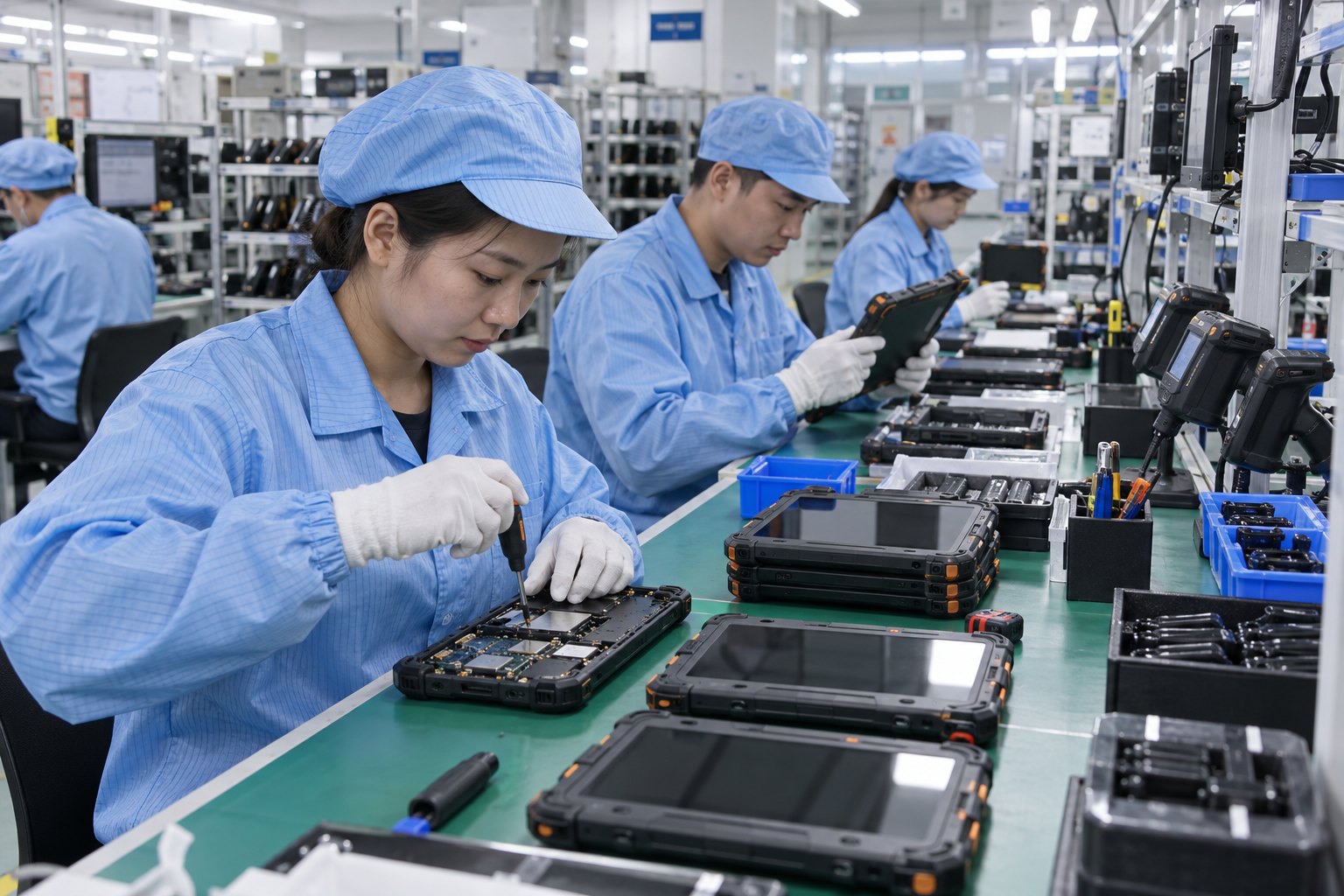
| Requirement | Recommended Spec | Rationale |
|---|---|---|
| Screen size | 8.0" – 10.1" | Portability + visibility balance |
| Connectivity | Ethernet + Wi-Fi | Fixed stations + mobile use |
| OS | Windows 11 or Android | Application dependency |
| IP rating | IP65 | Metal shavings, coolant mist |
Field Service & Maintenance
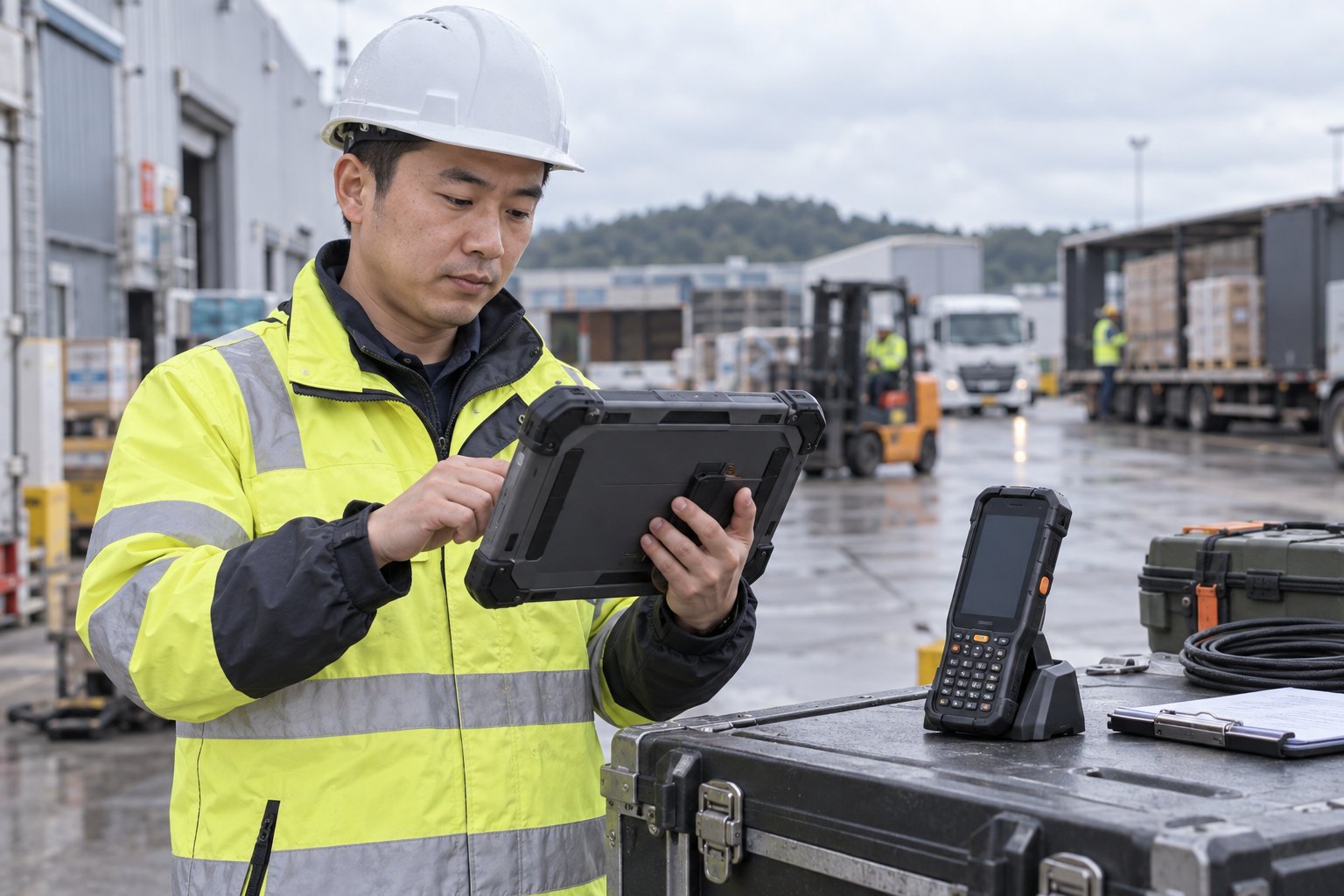
| Requirement | Recommended Spec | Rationale |
|---|---|---|
| Screen size | 8.0" | One-handed, pocketable |
| Connectivity | 4G/5G + GNSS GPS | Remote location work |
| Sunlight readability | 1000+ nits | Outdoor direct sun |
| IP rating | IP67 | Rain, mud, vehicle use |
Cold-Chain Logistics
| Requirement | Recommended Spec | Rationale |
|---|---|---|
| Operating temp | -20°C option | Freezer/cold room operation |
| Screen | Heated element (defogger) | Prevent condensation/frost |
| Battery | Extended low-temp battery | Batteries discharge faster in cold |
| Handler | Glove-mode touchscreen | Operated with gloves |
Total Cost of Ownership (TCO) Analysis
Procurement decisions based solely on unit purchase price dramatically underestimate true costs. A proper TCO analysis for a 500-device deployment over 3 years:
| Cost Category | Consumer Tablet (Est.) | Rugged Tablet (Est.) |
|---|---|---|
| Hardware (500 units × $400 / $700) | $200,000 | $350,000 |
| Protective cases | +$25,000 ($50/unit) | $0 (built-in) |
| Annual breakage (15% vs 2%) | $120,000 (225 replacements) | $14,000 (10 replacements) |
| IT support labor | +$45,000 | +$5,000 |
| Downtime cost | +$80,000 (est.) | +$8,000 (est.) |
| 3-Year TCO | ~$470,000+ | ~$377,000 |
| TCO per device | $940+ | $754 |
| Savings | — | ~20% lower TCO |
Key insight: Despite 40-75% higher initial unit price, rugged tablets typically deliver 15-25% lower total cost of ownership over 3 years due to dramatically reduced failure rates.
OEM/ODM Customization Options
Xinhong provides comprehensive customization services for volume orders:
Hardware Customization
| Customization | Description | Lead Time |
|---|---|---|
| Additional I/O ports | Serial (RS-232/488), CAN bus, GPIO | 30–45 days |
| Battery upgrade | 10000 mAh, 12000 mAh, custom form factor | 15–30 days |
| Custom module integration | Specific RFID antenna, UHF, LoRaWAN, sensors | 45–60 days |
| Color/material | Custom chassis color, medical-grade materials | 30–45 days |
Software Customization
| Customization | Description | Lead Time |
|---|---|---|
| Boot animation/logo | Custom boot logo, startup animation | 3–5 days |
| Default apps | Pre-installed MDM client, enterprise apps, VPN | 5–7 days |
| Custom ROM | Modified Android build with locked-down features | 15–30 days |
| Firmware branding | Custom about-screen, OEM info, update server | 5–10 days |
Certification Support
| Certification | Region | Duration |
|---|---|---|
| FCC / IC | North America | 2–3 weeks |
| CE / UKCA | Europe / UK | 2–3 weeks |
| RoHS / REACH | EU environmental | 1–2 weeks |
| UN38.3 | Lithium battery transport | 1 week |
| CCC | China compulsory | 3–4 weeks |
Frequently Asked Questions
What is the typical lead time for standard rugged tablet orders?
Do rugged tablets support Google Mobile Services (GMS)?
Can rugged tablets be used as fixed/kiosk terminals?
What warranty does Xinhong provide?
How do I integrate rugged tablets with our existing WMS/ERP system?
What is the minimum order quantity (MOQ)?
Do you ship internationally?
How do I request a quotation?
Request a Quote or Sample
Tell us your screen size, OS, scanner, IP rating, and quantity. We reply within 12 hours with a fixed quotation.