Fingerprint Industrial Tablet Applications: Capacitive Capture for Identity Verification and Mobile Operations
In warehouse identity compliance, parcel acceptance screening, government on-site services, and mobile banking operations, staff must complete identity verification and leave traceable records at changing locations. A fingerprint industrial tablet integrates fingerprint capture, ID card reading, facial verification, and business processing into a single rugged device, and has become an increasingly common tool in these workflows. This article reviews the technical approaches, verification flow, and selection criteria for fingerprint recognition on industrial tablets.
1. Why industrial tablets need fingerprint recognition
Manual comparison of a document photo against a person is slow and error-prone. Once a fingerprint module is integrated into the tablet, verification can be reduced to two steps: read the ID card to confirm identity information, then capture the fingerprint for matching. The system records the result, timestamp, and location automatically.
Compared with a consumer phone plus external accessories, an integrated industrial tablet offers three advantages. First, fingerprint capture, ID reading, scanning, and printing happen on one device, which removes pairing failures and reduces device management overhead. Second, the device is ruggedized for dust, vibration, and outdoor environments. Third, the terminal can carry a PSAM security chip, so verification data is encrypted locally before upload, which matters for identity compliance projects.
2. Technical points of capacitive fingerprint capture
Capacitive sensing is the common approach on industrial tablets. When a finger presses the sensor, ridges and valleys create different capacitance values, from which the chip reconstructs a fingerprint image and extracts features for matching.
Several indicators matter when evaluating a module. The first is the balance between false rejection rate and false acceptance rate; pushing one down usually raises the other, so both must be reviewed together. The second is liveness detection, which distinguishes a real finger from a replica and is essential in identity verification. The third is environmental tolerance, including dry, peeling, or oily fingers and low-temperature conditions, all common in warehouse and outdoor work. The fourth is capture speed and the number of allowed retries, which affect first-pass success rate.
Reliability does not depend on the module alone. Whether the terminal supports offline second-generation ID card reading, whether matching runs locally, and whether data is encrypted in transit all determine whether the process is compliant.
3. Combining multiple verification factors
In real projects, fingerprints are usually combined with facial recognition and ID reading rather than used alone.
The first combination is ID card plus fingerprint. The reader reads the chip, then the fingerprint is captured and matched against the data in the document. This approach does not depend on network connectivity, which suits warehouses, industrial parks, and remote sites.
The second is ID card plus face plus fingerprint. Facial recognition completes the first check quickly, and the fingerprint serves as a fallback when face quality is poor, such as when a worker wears a helmet or protective mask, or works in low light. Liveness detection typically requires a distance of 0.2 to 1.5 meters, with accuracy above 99.72 percent and a single recognition time under one second.
4. Typical application scenarios
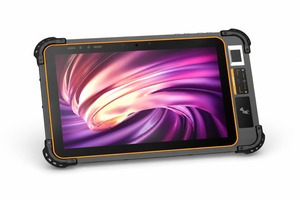
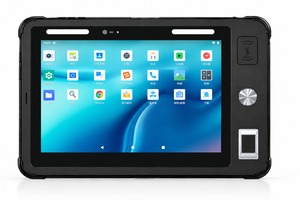
Warehouse and courier identity compliance. The acceptance step requires verifying the sender and retaining a record. An 8-inch industrial tablet weighs about 890 grams and can be held with one hand; combined with a barcode engine it completes parcel scanning and identity verification in one operation.
Mobile operations and dispatch management. Power inspection, gas metering, and equipment maintenance teams need to confirm that field staff have arrived on site. Fingerprint check-in replaces paper signatures, and the system records time and positioning data that management can review as a track.
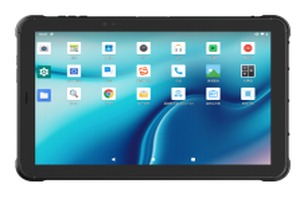
Government and financial on-site services. Social insurance review, account opening, and insurance claims often require a visit. A 10.1-inch industrial tablet offers a larger screen for showing forms and verification results, and can be paired with ID reading, fingerprint capture, facial recognition, and signature confirmation to complete the full workflow.
5. Selection criteria for fingerprint tablets
Screen size comes first. 8-inch models suit long handheld operation, while 10-inch and larger models suit scenarios that require showing forms, drawings, or on-site confirmation.
Security chips come second. For identity and financial projects, confirm whether the terminal supports PSAM slots and whether data can be encrypted locally.
Battery life comes third. A 10000mAh battery supports about 8 hours of continuous work and over 300 hours of standby, covering a full shift without interrupting operations.
Connectivity and positioning come fourth. The device should support 4G, dual-band WiFi, and Bluetooth, and offer BeiDou, GPS, and Glonass positioning so data synchronization holds up in signal-obstructed environments.
Scanning and expandability come fifth. If parcel labels and goods barcodes are handled together, confirm the scan engine model and supported symbologies. Common engines include Honeywell and Zebra series, covering PDF417, Data Matrix, QR Code, and Aztec.
6. Summary
The value of a fingerprint industrial tablet lies less in the speed of a single module than in combining ID reading, fingerprint capture, facial verification, and business processing on one portable rugged terminal, so verification that once required a service counter can move to the field. When selecting a model, start from compliance requirements: determine whether PSAM encryption is required and whether offline verification is needed, then decide on screen size and optional modules.
1. Why industrial tablets need fingerprint recognition
Manual comparison of a document photo against a person is slow and error-prone. Once a fingerprint module is integrated into the tablet, verification can be reduced to two steps: read the ID card to confirm identity information, then capture the fingerprint for matching. The system records the result, timestamp, and location automatically.
Compared with a consumer phone plus external accessories, an integrated industrial tablet offers three advantages. First, fingerprint capture, ID reading, scanning, and printing happen on one device, which removes pairing failures and reduces device management overhead. Second, the device is ruggedized for dust, vibration, and outdoor environments. Third, the terminal can carry a PSAM security chip, so verification data is encrypted locally before upload, which matters for identity compliance projects.
2. Technical points of capacitive fingerprint capture
Capacitive sensing is the common approach on industrial tablets. When a finger presses the sensor, ridges and valleys create different capacitance values, from which the chip reconstructs a fingerprint image and extracts features for matching.
Several indicators matter when evaluating a module. The first is the balance between false rejection rate and false acceptance rate; pushing one down usually raises the other, so both must be reviewed together. The second is liveness detection, which distinguishes a real finger from a replica and is essential in identity verification. The third is environmental tolerance, including dry, peeling, or oily fingers and low-temperature conditions, all common in warehouse and outdoor work. The fourth is capture speed and the number of allowed retries, which affect first-pass success rate.
Reliability does not depend on the module alone. Whether the terminal supports offline second-generation ID card reading, whether matching runs locally, and whether data is encrypted in transit all determine whether the process is compliant.
3. Combining multiple verification factors
In real projects, fingerprints are usually combined with facial recognition and ID reading rather than used alone.
The first combination is ID card plus fingerprint. The reader reads the chip, then the fingerprint is captured and matched against the data in the document. This approach does not depend on network connectivity, which suits warehouses, industrial parks, and remote sites.
The second is ID card plus face plus fingerprint. Facial recognition completes the first check quickly, and the fingerprint serves as a fallback when face quality is poor, such as when a worker wears a helmet or protective mask, or works in low light. Liveness detection typically requires a distance of 0.2 to 1.5 meters, with accuracy above 99.72 percent and a single recognition time under one second.
4. Typical application scenarios
Warehouse and courier identity compliance. The acceptance step requires verifying the sender and retaining a record. An 8-inch industrial tablet weighs about 890 grams and can be held with one hand; combined with a barcode engine it completes parcel scanning and identity verification in one operation.
Mobile operations and dispatch management. Power inspection, gas metering, and equipment maintenance teams need to confirm that field staff have arrived on site. Fingerprint check-in replaces paper signatures, and the system records time and positioning data that management can review as a track.
Government and financial on-site services. Social insurance review, account opening, and insurance claims often require a visit. A 10.1-inch industrial tablet offers a larger screen for showing forms and verification results, and can be paired with ID reading, fingerprint capture, facial recognition, and signature confirmation to complete the full workflow.
5. Selection criteria for fingerprint tablets
Screen size comes first. 8-inch models suit long handheld operation, while 10-inch and larger models suit scenarios that require showing forms, drawings, or on-site confirmation.
Security chips come second. For identity and financial projects, confirm whether the terminal supports PSAM slots and whether data can be encrypted locally.
Battery life comes third. A 10000mAh battery supports about 8 hours of continuous work and over 300 hours of standby, covering a full shift without interrupting operations.
Connectivity and positioning come fourth. The device should support 4G, dual-band WiFi, and Bluetooth, and offer BeiDou, GPS, and Glonass positioning so data synchronization holds up in signal-obstructed environments.
Scanning and expandability come fifth. If parcel labels and goods barcodes are handled together, confirm the scan engine model and supported symbologies. Common engines include Honeywell and Zebra series, covering PDF417, Data Matrix, QR Code, and Aztec.
6. Summary
The value of a fingerprint industrial tablet lies less in the speed of a single module than in combining ID reading, fingerprint capture, facial verification, and business processing on one portable rugged terminal, so verification that once required a service counter can move to the field. When selecting a model, start from compliance requirements: determine whether PSAM encryption is required and whether offline verification is needed, then decide on screen size and optional modules.