The A3 commercial document scanner has entered mass production, targeting government service counters, finance departments, medical record rooms and quality inspection teams that process paper documents at high volume.
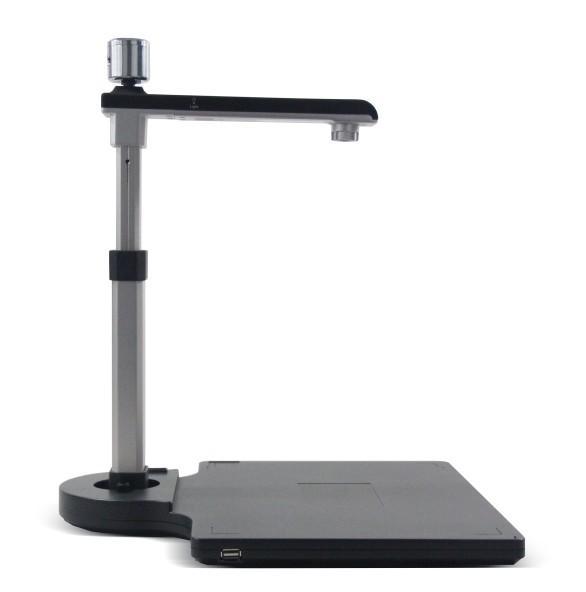
Unlike a flatbed scanner, the document camera uses a cantilever camera structure: place the document on the base board and capture the full page with one click — no line-by-line scanning, and no need to unbind bound contracts or ledgers. Items a flatbed cannot handle, such as ID cards, cards and equipment nameplates, can simply be photographed.
1. Core specifications
This A3 model uses a 16-megapixel CMOS sensor with per-page capture under one second, covering A3, A4 and A5 formats as well as three-dimensional objects. Software features include OCR (searchable PDF and Word output), barcode recognition, auto-deskew and cropping, and continuous capture. An SDK is available so business systems can call face recognition and document recognition capabilities.
2. Typical deployment
Government counters capture ID cards, household registers and application forms on the spot, removing the copying step. Finance and legal teams digitize contracts, invoices and accounting vouchers in bulk without unbinding ledgers. Hospital record rooms digitize historical paper records to support electronic medical record programmes. Quality inspection teams photograph nameplates and component conditions and link them to inspection records.
3. Fitting into paperless workflows
In a complete paperless process, the document camera handles the entry of paper material into the system, the signature pad handles signing, and the dual-screen ID verification terminal handles identity confirmation. Combined, a counter can complete material capture, identity verification and electronic signing in one pass, with no paper archive retained.
4. Throughput estimate
At 500 pages per day, a flatbed scanner at roughly eight seconds per page plus paper handling occupies one person for over an hour. The document camera at around one second per page with auto-deskew and continuous capture finishes in ten to fifteen minutes. Over a month the labour saving typically exceeds the equipment cost, which is why government halls and record rooms have been switching in volume over the past two years.
5. Buying notes
Focus on four items: sensor resolution and focus speed; format coverage (the A3 versus A4 price gap is usually small, so leave A3 headroom); whether the software and SDK can integrate with the existing business system; and practical details such as the folding cantilever and base board alignment frame that affect how fast documents can be positioned.
Unlike a flatbed scanner, the document camera uses a cantilever camera structure: place the document on the base board and capture the full page with one click — no line-by-line scanning, and no need to unbind bound contracts or ledgers. Items a flatbed cannot handle, such as ID cards, cards and equipment nameplates, can simply be photographed.
1. Core specifications
This A3 model uses a 16-megapixel CMOS sensor with per-page capture under one second, covering A3, A4 and A5 formats as well as three-dimensional objects. Software features include OCR (searchable PDF and Word output), barcode recognition, auto-deskew and cropping, and continuous capture. An SDK is available so business systems can call face recognition and document recognition capabilities.
2. Typical deployment
Government counters capture ID cards, household registers and application forms on the spot, removing the copying step. Finance and legal teams digitize contracts, invoices and accounting vouchers in bulk without unbinding ledgers. Hospital record rooms digitize historical paper records to support electronic medical record programmes. Quality inspection teams photograph nameplates and component conditions and link them to inspection records.
3. Fitting into paperless workflows
In a complete paperless process, the document camera handles the entry of paper material into the system, the signature pad handles signing, and the dual-screen ID verification terminal handles identity confirmation. Combined, a counter can complete material capture, identity verification and electronic signing in one pass, with no paper archive retained.
4. Throughput estimate
At 500 pages per day, a flatbed scanner at roughly eight seconds per page plus paper handling occupies one person for over an hour. The document camera at around one second per page with auto-deskew and continuous capture finishes in ten to fifteen minutes. Over a month the labour saving typically exceeds the equipment cost, which is why government halls and record rooms have been switching in volume over the past two years.
5. Buying notes
Focus on four items: sensor resolution and focus speed; format coverage (the A3 versus A4 price gap is usually small, so leave A3 headroom); whether the software and SDK can integrate with the existing business system; and practical details such as the folding cantilever and base board alignment frame that affect how fast documents can be positioned.