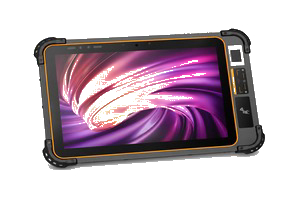
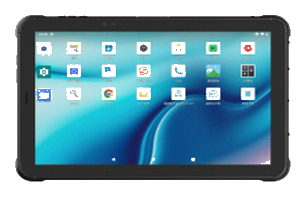
Industrial smart terminals have gone through a clear product iteration over the past two years. Early field terminals were built around one requirement: survival — drop resistance, dust protection and long battery life. As business systems in warehousing, manufacturing and government services mature, the terminal is shifting from a simple data capture endpoint to an edge node with local compute. Three trends are taking shape in 2026.
1. Edge AI moves inference onto the device
Historically, data captured by an industrial tablet was uploaded and judged on the server. As real-time requirements grow, more inference now runs locally: liveness detection for face recognition, barcode quality pre-screening, and first-pass filtering of defect images.
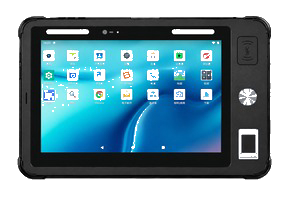
This sets clear hardware requirements: the platform needs compute headroom, memory should start at 4GB, and power and thermal behaviour must stay acceptable. A platform such as the MTK 6765 octa-core 2.3GHz running Android 12 can handle common edge tasks — local face detection, multi-symbology decoding — while still covering a full shift on battery.
2. Domestic platform migration becomes an acceptance item
In government, finance and energy projects, requirements around domestic platforms have moved from encouragement to acceptance criteria. This spans the processor platform, operating system, cryptographic algorithms (SM2/SM3/SM4) and secure element slots (PSAM / SAM).
For buyers the practical implication is simple: confirm national cryptographic algorithm support, secure element slots and the relevant test reports during selection — not during system integration. Industrial tablets, handheld terminals and ID verification terminals each need separate confirmation.
3. Modular customization becomes the differentiator
Standard models increasingly fail to match differentiated field requirements. In a single logistics company, pickers need lightweight handhelds, receiving staff need large screens, and dock areas need fixed verification posts. Covering every role with one high-spec model wastes budget.
Modular customization is therefore becoming mainstream: start from a mature platform, then select the scan engine, RFID band, ID document reader, fingerprint and face modules as needed, and adjust structure, silkscreen and software per role.
Three practical recommendations
First, define the environment before the configuration: dust, water exposure, minimum temperature and drop height determine the IP rating and temperature range, and these are non-negotiable. Second, specify per role rather than one-size-fits-all. Third, move compliance forward — where real-name verification, national cryptography or industry testing apply, request the reports during selection.
1. Edge AI moves inference onto the device
Historically, data captured by an industrial tablet was uploaded and judged on the server. As real-time requirements grow, more inference now runs locally: liveness detection for face recognition, barcode quality pre-screening, and first-pass filtering of defect images.
This sets clear hardware requirements: the platform needs compute headroom, memory should start at 4GB, and power and thermal behaviour must stay acceptable. A platform such as the MTK 6765 octa-core 2.3GHz running Android 12 can handle common edge tasks — local face detection, multi-symbology decoding — while still covering a full shift on battery.
2. Domestic platform migration becomes an acceptance item
In government, finance and energy projects, requirements around domestic platforms have moved from encouragement to acceptance criteria. This spans the processor platform, operating system, cryptographic algorithms (SM2/SM3/SM4) and secure element slots (PSAM / SAM).
For buyers the practical implication is simple: confirm national cryptographic algorithm support, secure element slots and the relevant test reports during selection — not during system integration. Industrial tablets, handheld terminals and ID verification terminals each need separate confirmation.
3. Modular customization becomes the differentiator
Standard models increasingly fail to match differentiated field requirements. In a single logistics company, pickers need lightweight handhelds, receiving staff need large screens, and dock areas need fixed verification posts. Covering every role with one high-spec model wastes budget.
Modular customization is therefore becoming mainstream: start from a mature platform, then select the scan engine, RFID band, ID document reader, fingerprint and face modules as needed, and adjust structure, silkscreen and software per role.
Three practical recommendations
First, define the environment before the configuration: dust, water exposure, minimum temperature and drop height determine the IP rating and temperature range, and these are non-negotiable. Second, specify per role rather than one-size-fits-all. Third, move compliance forward — where real-name verification, national cryptography or industry testing apply, request the reports during selection.