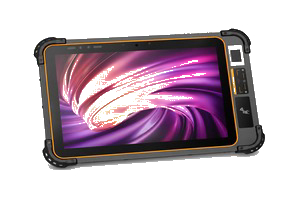
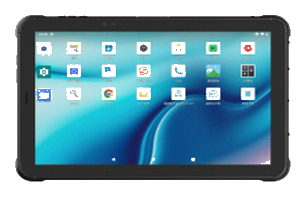
Ask anyone seeing a rugged tablet quote for the first time and the reaction is identical: same screen size, same Android, several times the money. Is that nothing but badge premium?
Not entirely — branding plays some part — but most of that gap maps onto something physical. And those things exist to solve a different problem, which is that consumer tablets do not last on a working floor.
The shell is the first line of defence
Consumer tablets are built around thinness and feel. Thin-wall aluminium or plastic, and almost no crush space to speak of.
Rugged units usually carry a metal frame underneath with an energy-absorbing layer over the top. On impact the outer layer takes the hit and whatever gets through is spread across the frame.
It costs you thickness, and it costs you weight.
Then there is the cover glass. Industrial devices use chemically strengthened glass with protection carried around the edge. The consumer equivalent is thinner and considerably more fragile, and that one component alone can account for a surprising slice of total cost.
Where the money really goes is the part you cannot see
Behind IP65 or IP67 sits an entire sealing process. Port plugs. Acoustic vents using waterproof membranes. Silicone gaskets along every shell joint. Ultrasonic welding or precision dispensing during assembly.
None of that can be retrofitted with a fancy case. It has to exist when the unit leaves the factory.
There is a side effect too, and it catches people out: sealing wrecks your thermal headroom. A sealed unit cannot dump heat through free airflow the way a consumer product can, so heat has to be conducted along an internal path out to the chassis. Designing and validating that path is another line of cost — and part of the reason rugged hardware is chunky.
The screen has to survive daylight
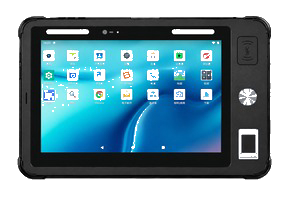
Reading conditions outdoors or on a shop floor have nothing in common with an office. Standard panels wash out completely under direct sun, so industrial displays target far higher brightness and pair it with anti-glare treatment to keep things legible.
Touch adds cost of its own. Does it work through gloves. Does it work with wet hands. How does it reject a palm resting on the edge. Each needs specific hardware and repeated calibration. Consumer vendors will not fund that for a handful of users; on site it is non-negotiable.
Swappable batteries run directly against going thin
Operations running multiple shifts have no window to sit and charge. Two requirements follow: the pack has to hold up across a wide temperature band, and on plenty of sites it has to come out without powering down.
A removable pack means keeping a proper latch mechanism and a contact design that lasts — which is the exact opposite direction from sealed unibody construction.
The usual buying mistake is comparing capacity alone and forgetting cycle life. Daily charging, or worse a multi-shift pattern, puts you near the replacement point within two or three years. What decides your real spend is when you buy the second round of packs, not what the label said in milliamp-hours.
Testing is where they actually separate
Most overlooked line item, and the one that most reliably separates real products from cosmetic ones.
Genuine rugged hardware goes through drop, vibration, thermal cycling, humidity and salt fog before it ships, and there are records on file showing it happened.
Take the MIL-STD-810 family. It covers something like a dozen environmental methods, and every temperature class and every impact face gets run separately. Test time and the prototypes consumed during it are real money. When a device says military grade but the vendor cannot produce matching records, that usually means it just looks tough.
Worth adding: two products claiming the same ingress rating can sit on very different test conditions and pass criteria. Comparing nothing but the headline grade hides most of what matters.

Being able to buy the same unit in three years is worth real money
Consumer tablets turn over annually, and nobody commits to supply or firmware updates for years afterwards.
Industrial buying does not work like that. Fifty units this year, another thirty of the identical model next year going into the same system, with the expectation that OS builds and accessories stay stable across three to five years.
"Same model, stable supply" obliges the vendor to hold tooling and stocks of specific components for years on end. Naturally that lands in unit cost.
To an industrial buyer that certainty beats a cheaper one-off price every time. Lose the model and you start again — revalidation, new accessories, new management process.
Cases where you genuinely do not need rugged
In fairness, not every deployment does.
Dry, climate-controlled, low-dust indoor work where units rarely get dropped, counts are small, and a replacement does not stop production — a consumer tablet inside a decent protective case genuinely saves money.
But touch any one of these and go with real rugged hardware instead:
Dust or liquid getting splashed around. Continuous vibration from vehicles. Sustained work at temperature extremes. Any real chance of falling off a forklift or off racking. Or a requirement to keep buying the same model for three to five years.
So, is it worth it
The rugged premium buys you fewer outages, lower replacement frequency, and supply you can plan around.
The honest way to decide is arithmetic. Take expected replacements across the ownership period, add what each outage actually costs the business, add the labour for re-integration, then set that against the difference in unit price.
For most sites that sum resolves itself pretty fast.
To work through it properly, see our breakdown of total cost of ownership, or go straight to the specifications on our rugged tablets.
Not entirely — branding plays some part — but most of that gap maps onto something physical. And those things exist to solve a different problem, which is that consumer tablets do not last on a working floor.
The shell is the first line of defence
Consumer tablets are built around thinness and feel. Thin-wall aluminium or plastic, and almost no crush space to speak of.
Rugged units usually carry a metal frame underneath with an energy-absorbing layer over the top. On impact the outer layer takes the hit and whatever gets through is spread across the frame.
It costs you thickness, and it costs you weight.
Then there is the cover glass. Industrial devices use chemically strengthened glass with protection carried around the edge. The consumer equivalent is thinner and considerably more fragile, and that one component alone can account for a surprising slice of total cost.
Where the money really goes is the part you cannot see
Behind IP65 or IP67 sits an entire sealing process. Port plugs. Acoustic vents using waterproof membranes. Silicone gaskets along every shell joint. Ultrasonic welding or precision dispensing during assembly.
None of that can be retrofitted with a fancy case. It has to exist when the unit leaves the factory.
There is a side effect too, and it catches people out: sealing wrecks your thermal headroom. A sealed unit cannot dump heat through free airflow the way a consumer product can, so heat has to be conducted along an internal path out to the chassis. Designing and validating that path is another line of cost — and part of the reason rugged hardware is chunky.
The screen has to survive daylight
Reading conditions outdoors or on a shop floor have nothing in common with an office. Standard panels wash out completely under direct sun, so industrial displays target far higher brightness and pair it with anti-glare treatment to keep things legible.
Touch adds cost of its own. Does it work through gloves. Does it work with wet hands. How does it reject a palm resting on the edge. Each needs specific hardware and repeated calibration. Consumer vendors will not fund that for a handful of users; on site it is non-negotiable.
Swappable batteries run directly against going thin
Operations running multiple shifts have no window to sit and charge. Two requirements follow: the pack has to hold up across a wide temperature band, and on plenty of sites it has to come out without powering down.
A removable pack means keeping a proper latch mechanism and a contact design that lasts — which is the exact opposite direction from sealed unibody construction.
The usual buying mistake is comparing capacity alone and forgetting cycle life. Daily charging, or worse a multi-shift pattern, puts you near the replacement point within two or three years. What decides your real spend is when you buy the second round of packs, not what the label said in milliamp-hours.
Testing is where they actually separate
Most overlooked line item, and the one that most reliably separates real products from cosmetic ones.
Genuine rugged hardware goes through drop, vibration, thermal cycling, humidity and salt fog before it ships, and there are records on file showing it happened.
Take the MIL-STD-810 family. It covers something like a dozen environmental methods, and every temperature class and every impact face gets run separately. Test time and the prototypes consumed during it are real money. When a device says military grade but the vendor cannot produce matching records, that usually means it just looks tough.
Worth adding: two products claiming the same ingress rating can sit on very different test conditions and pass criteria. Comparing nothing but the headline grade hides most of what matters.
Being able to buy the same unit in three years is worth real money
Consumer tablets turn over annually, and nobody commits to supply or firmware updates for years afterwards.
Industrial buying does not work like that. Fifty units this year, another thirty of the identical model next year going into the same system, with the expectation that OS builds and accessories stay stable across three to five years.
"Same model, stable supply" obliges the vendor to hold tooling and stocks of specific components for years on end. Naturally that lands in unit cost.
To an industrial buyer that certainty beats a cheaper one-off price every time. Lose the model and you start again — revalidation, new accessories, new management process.
Cases where you genuinely do not need rugged
In fairness, not every deployment does.
Dry, climate-controlled, low-dust indoor work where units rarely get dropped, counts are small, and a replacement does not stop production — a consumer tablet inside a decent protective case genuinely saves money.
But touch any one of these and go with real rugged hardware instead:
Dust or liquid getting splashed around. Continuous vibration from vehicles. Sustained work at temperature extremes. Any real chance of falling off a forklift or off racking. Or a requirement to keep buying the same model for three to five years.
So, is it worth it
The rugged premium buys you fewer outages, lower replacement frequency, and supply you can plan around.
The honest way to decide is arithmetic. Take expected replacements across the ownership period, add what each outage actually costs the business, add the labour for re-integration, then set that against the difference in unit price.
For most sites that sum resolves itself pretty fast.
To work through it properly, see our breakdown of total cost of ownership, or go straight to the specifications on our rugged tablets.