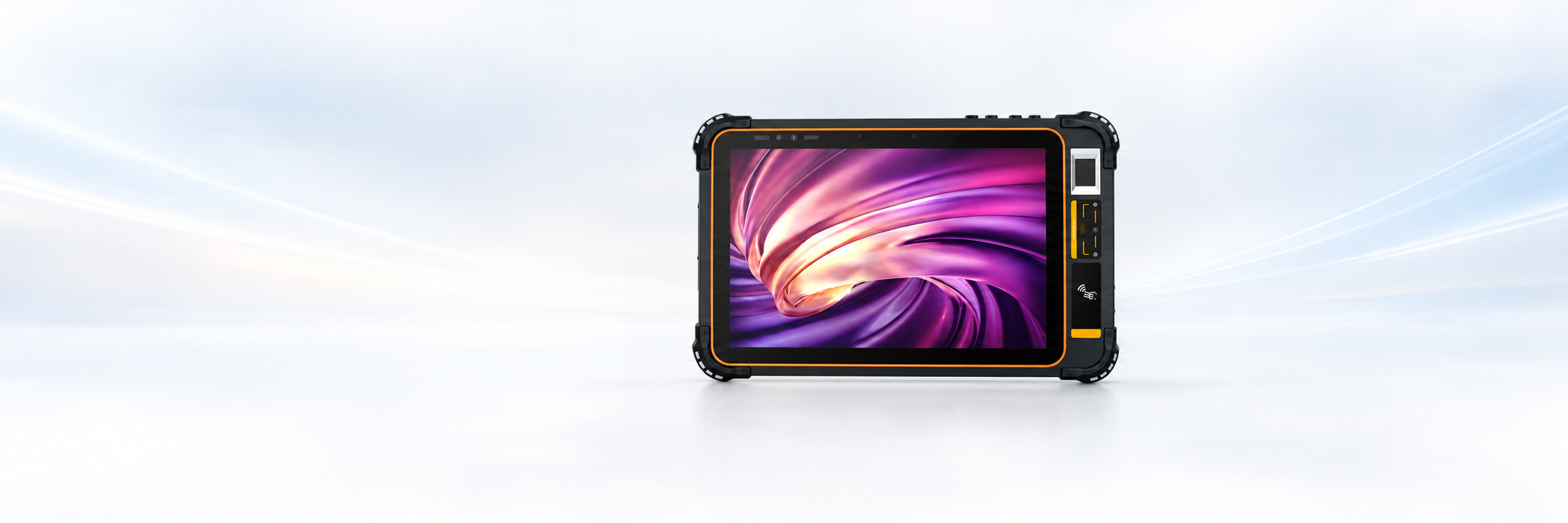
The IP code is the most quoted — and most misunderstood — specification on any rugged tablet datasheet. This guide explains what each digit means, compares IP65/IP67/IP68/IP69K, and covers the four things IP ratings do not protect against. It complements our Industrial Tablet Buying Guide 2026.
Quick Answer
| Your environment | Minimum rating |
|---|---|
| Indoor warehouse, light airborne dust | IP65 |
| Outdoor yard work, rain, mixed indoor/outdoor fleets | IP67 |
| Maritime, food washdown, pressure-steam cleaning | IP68 / IP69K |
| Chemical splash (oils, solvents, disinfectants) | IP67 + chemical compatibility check |
Anatomy of the IP Code (IEC 60529)
An IP code has two digits. The first describes protection against solid objects; the second against liquids. A higher number is not universally "better" — each describes a specific test.
First Digit — Solids
| Digit | Meaning | Detail |
|---|---|---|
| 5 | Dust-protected | Limited ingress permitted; not fully sealed |
| 6 | Dust-tight | No ingress after 8 hours in a dust chamber; vacuum test |
For industrial duty always require first digit 6. Digit 5 allows enough ingress to cause long-term failures with metal or mineral dust.
Second Digit — Liquids
| Digit | Test condition | Practical translation |
|---|---|---|
| 5 | 6.3 mm nozzle, 12.5 L/min, 3 min from 3 m | Low-pressure jets — cleaning spray |
| 6 | 12.5 mm nozzle, 100 L/min, 3 min from 3 m | Powerful jets — heavy washdown |
| 7 | Immersion 1 m depth, 30 min | Rain, puddles, accidental submersion |
| 8 | Continuous immersion, manufacturer specifies depth & duration | Varies — ask specifics |
| 9K | Steam jet 80 °C, 80–100 bar, close range | High-pressure hot washdown |
IP65 vs IP67 vs IP68: Side by Side
| Aspect | IP65 | IP67 | IP68 |
|---|---|---|---|
| Dust | Protected (limited ingress) | Dust-tight | Dust-tight |
| Water | Low-pressure jets | 1 m / 30 min immersion | Immersion per maker spec |
| Rain / snow | Adequate | Excellent | Excellent |
| Submersion recovery | Not rated | Yes (1 m, 30 min) | Yes (terms vary) |
| Hose cleaning | Light only | Moderate | High (verify conditions) |
| Cost impact | Baseline | +3–8% | +10–25% |
| Typical deployment | Indoor logistics | Mixed indoor/outdoor fleets | Marine, washdown |
The trap: "IP68" without stated conditions is marketing. Ask: Depth? Duration? Fresh or salt water? Tested by whom?
IK Impact Rating — The Missing Half
IP says nothing about hitting things. For that you need the IK code (IEC 62262), measured in impact joules:
| Rating | Impact energy | Real-world equivalent |
|---|---|---|
| IK06 | 1 J | Light knocks |
| IK07 | 2 J | Drop of a small tool |
| IK08 | 5 J | Recommended industrial minimum |
| IK09 / IK10 | 10 J / 20 J | Vandal-resistant, heavy equipment |
Ask for IK07 minimum, IK08 preferred. Pair it with MIL-STD-810H drop certification, which simulates actual falls rather than pendulum impacts — both are explained in our drop resistance section.
What IP Ratings Do NOT Cover
This is where most buying mistakes happen. A dust-tight, immersion-proof tablet can still fail tomorrow if you ignore these:
- Temperature. IP ≠ cold or heat survival. Specify operating range separately (-10 °C to 60 °C standard; -20 °C/-30 °C for cold chain).
- Chemicals. Oils, solvents and disinfectants attack gaskets and polycarbonate even when water does not. Request chemical compatibility data.
- Vibration. Vehicle-mounted units need MIL-STD-810H Method 514 vibration validation, independent of IP.
- Salt fog / corrosion. Marine and coastal deployments need salt-fog testing (IEC 60068-2-52), not just IP67.
- Altitude & pressure and EMC/EMI behavior in industrial RF environments.

How to Verify a Vendor's IP Claim
- Request the third-party laboratory report — SGS, TUV, Intertek or equivalent — not only a datasheet icon.
- Verify the standard cited is IEC 60529 and check the report date.
- Confirm the tested unit matches your purchased configuration (same ports, covers, battery door, dock).
- Ask whether accessories were included in testing — docks and sleds change the sealing path.
- Get specific IP68 conditions written into the purchase contract.
Xinhong provides test reports for each shipped configuration and specifies exact IP68 terms where applicable.
Selection Matrix by Application
| Application | IP | Also require |
|---|---|---|
| Indoor warehouse picking | IP65 | IK07+, MIL-STD-810H |
| Outdoor yard / port operations | IP67 | Salt-fog test, wide temp |
| Cold-chain logistics | IP67 | -20/-30 °C rating, heated display, glove mode |
| Food & beverage processing | IP69K | Stainless-safe housings, chemical resistance |
| Pharmaceutical cleanroom | IP65–IP67 | Disinfectant compatibility, low outgassing |
| Construction site | IP67 | IK08+, high drop spec, sunlight display |
| Marine / offshore | IP67–IP68 | Salt-fog, corrosion-resistant fasteners |
Xinhong Recommendation
- Most industrial buyers: specify IP67 (dust-tight + 1 m immersion) — best protection-to-cost balance.
- Always pair it with IK07/IK08 impact rating and MIL-STD-810H documentation.
- Written into the PO: exact IP test conditions, temperature range, and whether accessories were included.
Not sure which combination fits your site? Send us your environment description and we will specify honestly — including telling you when IP65 is sufficient and saving you money.
Frequently Asked Questions
Is IP68 automatically better than IP67?
Can I use an IP67 tablet in heavy rain all day?
What is IP69K and who needs it?
Does an IP rating cover screen cracking from drops?
My tablet is IP67 but the touchscreen failed in a freezer. Why?
How do I verify a supplier IP claim is real?
Do port covers and accessories affect the rating?
What is IK rating and which level should I ask for?
Is IP65 enough for indoor warehouses?
Does higher IP always mean higher cost?
Get a Protection Spec Written for Your Environment
Describe your dust, water, chemicals and temperature conditions. We reply within 12 hours with a matched IP/IK/MIL-STD specification and test documentation.